


Have you seen the beautiful chart recently created by Stig Kristiansen, a Norwegian graphic systems designer? He mapped out how each wavelength of light across the full solar spectrum - ultraviolet, visible and infrared - impacts specific biological processes and the various aspects of our health.
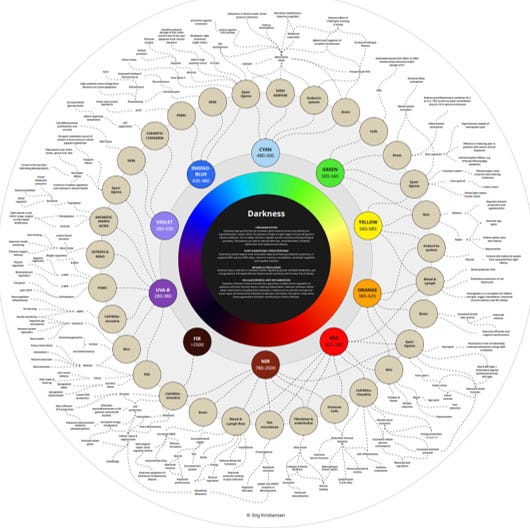
The first take home lesson from this chart is that virtually every visible color and invisible light wavelength has specific biological effects.
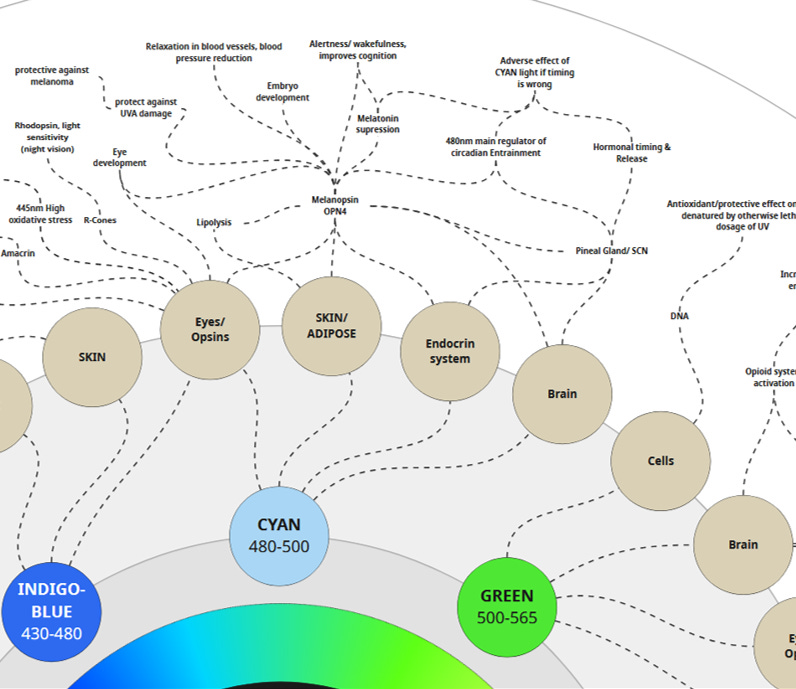
It is hard to see the all the detail so I have zoomed in one part of the chart below.
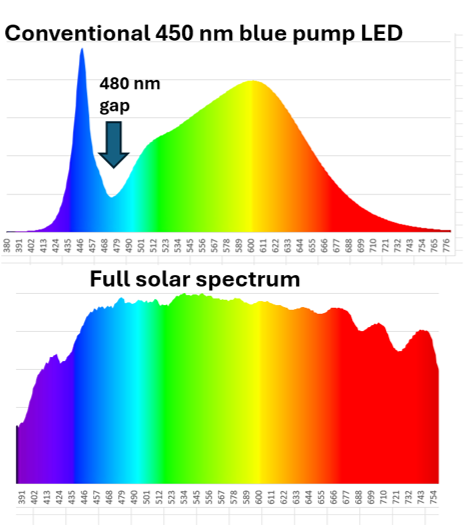
Readers of THE LIGHT DOCTOR newsletter know that the conventional blue pump LEDs that dominate the lighting market today are highly deficient in many of healthy wavelengths of light during the day (such as the 480 nm blue that syncs circadian clocks), and while providing harmful doses of blue light in the evening hours. They are also totally deficient other critical wavelengths, such 700-900 nm near-IR.
You might think the solution would be to use full spectrum electric lights that mimic the natural solar spectrum and provide as many wavelengths as possible.
Unfortunately, it is not so simple. Natural daylight is typically 100 times brighter than indoor electric light and delivers 100 times more total light energy across the full UV, visible and IR spectrum . Outdoors the visual brightness of light (photopic illumination) may vary between 5,000 and 50,000 lux or more. Indoors we live under 50 to 500 lux measured at the table top, and even less ( 40-60%) entering our eyes. We cannot tolerate much brighter light in closed indoor spaces because of glare and reflections.
While sunlight has sufficient energy at every wavelength to trigger all the physiological pathways and responses shown in Stig’s graphic chart, electric light usually does not have sufficient energy to trigger the whole gamut. This is because each physiological response depends on receiving a sufficient dose of light (i.e. fluence or radiant exposure) at each specific wavelength.
So you have to choose your target.
As an example, synchronizing the human circadian clock requires more than 20 microwatts per square centimeter (>20 µW/cm²) of sky-blue light between 440-495 nm entering our eyes (see pp.130-134 in THE LIGHT DOCTOR). Sunlight on a bright sunny day delivers on average 50,000 lux outdoors which translates to approximately 70 microwatts per square centimeter for every nanometer (70 µW/cm² /nm) across the visible light spectrum. So, sunlight delivers 70 µW/cm² x 55 nm = 3,850 µW/cm² of sky blue light which far exceeds what is needed to keep our circadian clocks in synch. Even on a cloudy overcast day with only 5,000 lux of daylight entering the eyes, the amount of sky blue wavelengths is 385 µW/cm² which is more than sufficient.
However, indoors at my desk I have a typical indoor level of 300 lux of illumination on the desktop, and only 120 lux of that enters my eyes. If I use a broad spectrum light with all wavelengths at the same level of intensity, then that 120 lux of light will only deliver 0.167 µW/cm² per nm, or a 440-495 nm blue total of 9.2 µW/cm². This is well below the 20 µW/cm² minimum dose of sky-blue light required to safely synchronize my circadian clocks.
There are two solutions if I am confined indoors and want to make sure I receive an effective indoor daytime dose of sky-blue light:
Triple the brightness of the full spectrum electric light to about 900 lux which would provide an adequate circadian dose of 27.5 µW/cm² 440-495 nm sky-blue light. But that would probably give me a headache because of the glare from an uncomfortably bright light.
Use a spectrally-engineered light during daytime hours which delivers a spike of >20 µW/cm² of sky-blue light without needing to increase the lux level of visible brightness more than is comfortable. An example of the Max Blue daytime light from Korrus OIO is shown in the chart below
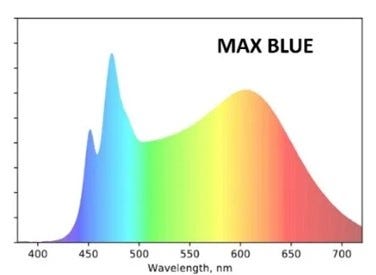
The bottom line is to be sure we are having the intended effects, we need to understand the minimum effective dose (i.e. fluence or radiant exposure) for each desired wavelength-dependent physiological effect in humans under normal indoor work and home environments.
Of course, by far the best way to get your daily dose of full spectrum light is to get outside in the mornings. But there are many people, because of sickness, infirmity, or occupation cannot do this. For them switching to circadian supportive lighting indoors is critical for their well-being.
Further Reading
The quickest way to understand the importance of healthy lighting is to read my book THE LIGHT DOCTOR.

Become an Annual Paid Subscriber to THE LIGHT DOCTOR newsletter
and get The Ultimate Circadian Bedroom Lighting Package as a free gift of healthy light and restful sleep with each new Annual Paid Subscription to THE LIGHT DOCTOR newsletter.
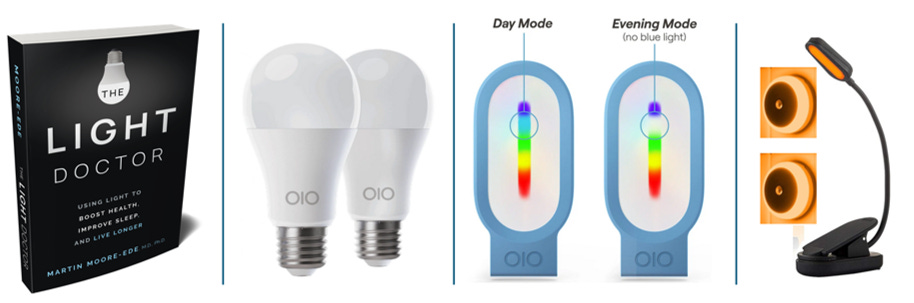
Here are the benefits you unlock with each new Paid Annual Subscription to THE LIGHT DOCTOR newsletter beginning today:
Ultimate Circadian Bedroom Lighting Package mailed to your home (for USA residents only*), including:
Latest edition of THE LIGHT DOCTOR book.
Blue-free book reading light - so you can read the book in the evening without any blue light exposure
Two A-19 automatic OIO circadian light bulbs which automatically cycle between blue-rich days, blue free evening lights and red night lights – so that your lighting is always healthy
OIO loop which enables you check any light fixture or bulb to see if it is providing healthy light appropriate for the time of day or night.
Hallway and bathroom blue-free night lights which automatically switch on when it is dark - so you safely walk to the bathroom without switching on the lights
Unlimited year-long access to all THE LIGHT DOCTOR newsletters, podcasts and premium resource materials.
Catalog of evidence-based healthy lighting products from reliable vendors.
The Ultimate Circadian Bedroom Lighting Package is the ideal gift for family and friends (or yourself) so you can bless them with healthy light and restful sleep,
Give yourself and your loved ones the gift of healthy bedroom lighting with each new Annual Paid Subscription to THE LIGHT DOCTOR newsletter
If you are already a paid monthly subscriber and wish to take advantage of this offer please go to the subscribe page and upgrade your subscription to an Annual Paid Subscriber. a
a Thanks again for supporting our campaign for healthy lighting
PLEASE NOTE: *The Ultimate Circadian Bedroom Lighting Package can only be shipped to USA residents because of electrical compatibility and current tariff fees. Residents of other countries who sign up for an Annual Paid Subscription to THE LIGHT DOCTOR newsletter will be shipped a signed copy of the latest edition of THE LIGHT DOCTOR.
We regret this offer is not available to monthly paid or complimentary subscribers - but you are welcome to upgrade to a Paid Annual Subscription
If you are already an Annual Paid Subscriber we will continue to honor your current lower annual subscription price when you automatically renew, but you will not receive the incentive package for new subscribers.
THE LIGHT DOCTOR newsletter by Dr. Martin Moore-Ede is a reader-supported publication. To receive new posts and support my work, consider becoming a free or paid subscriber.


