

Roadmap for Implementing Healthy Lighting
How to make 2026 the year for a breakthrough in the adoption of healthy lighting

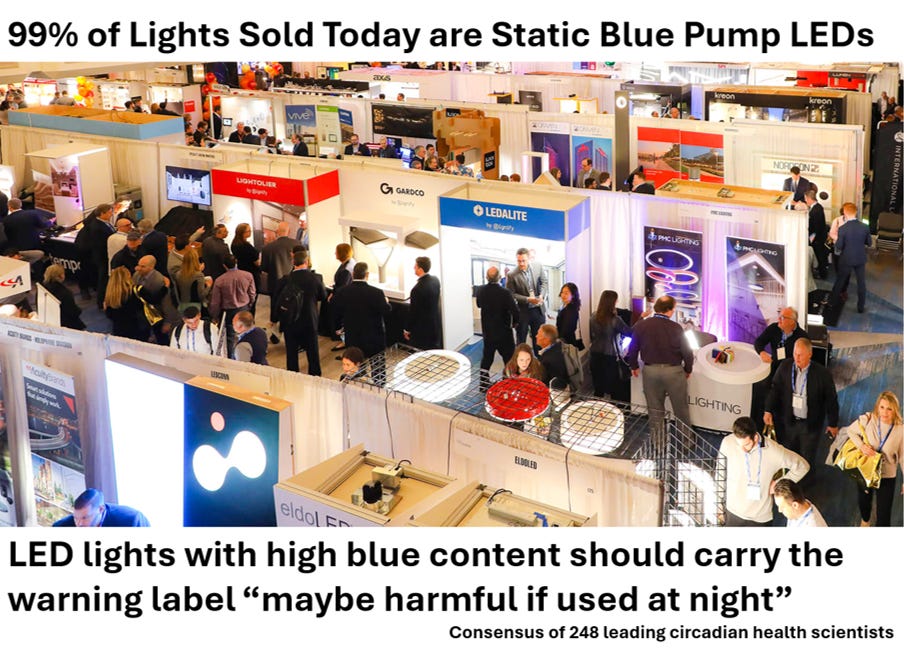
Lighting is not just for vision and aesthetics. As the readers of THE LIGHT DOCTOR newsletter know, there is considerable scientific evidence that the spectral composition, intensity and timing of visible and invisible light wavelengths have profound effects on human health. The evidence is so strong that 248 leading circadian health scientists reached consensus that “LED lights with high blue content should carry the warning label “maybe harmful if used at night”.
But this has not translated yet into the widespread adoption of healthy circadian lighting. The global circadian lighting market is estimated to be $261 million, compared to the total worldwide lighting market of ⁓$150 billion per year. This represents only a 0.2% market share.
We need an effective strategy to introduce healthy light
Merely promoting these scientific breakthroughs will not achieve the widespread introduction of health-promoting indoor lighting in homes, workplaces, hospitals, schools and other human-occupied spaces. There is a well-embedded status quo that gives us ubiquitous unchanging blue-pump LED lighting, and which unfortunately is promoting ill-health on a societal scale.
Addressing this failure of modern lighting requires a comprehensive roadmap strategy (see Figure 2) focusing on all the various factors and decisions made by lighting buyers and those who supply lighting. Don’t worry about the complexity of Figure 2, I will explain each part of it below.
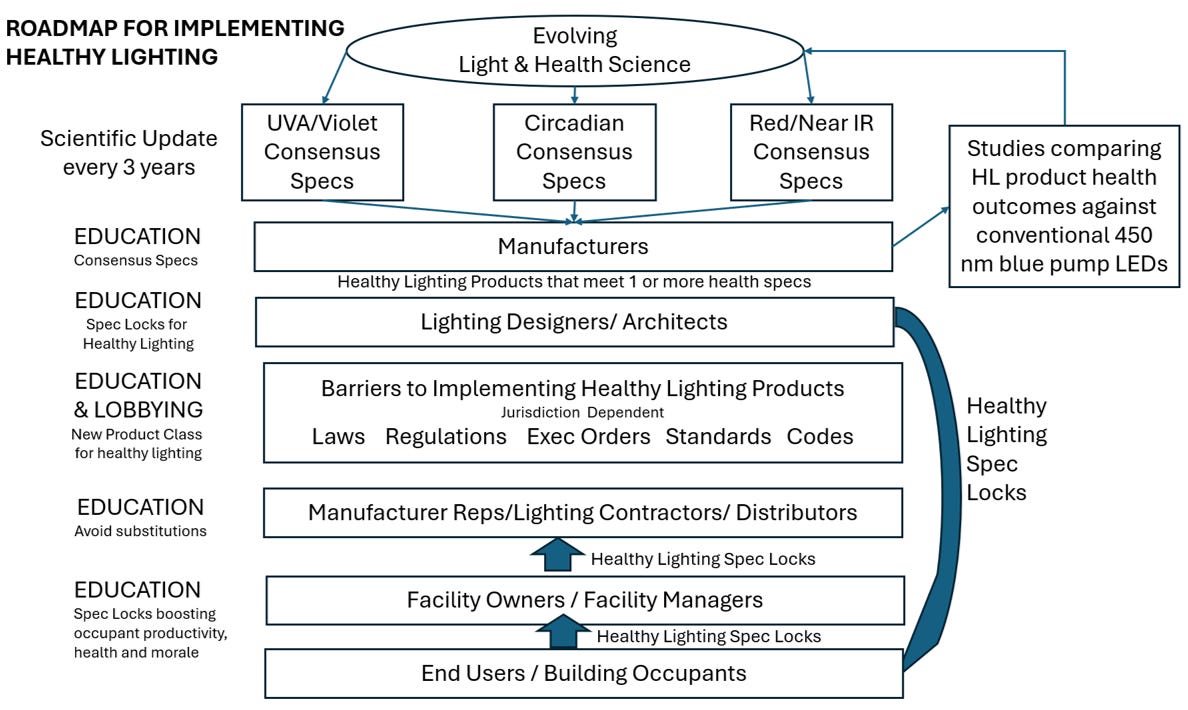
Figure 2: Roadmap of the stakeholders and processes in the introduction of healthy lighting
Evolving Light and Health Science
The science of light and health is continuously evolving. Thousands of peer-reviewed scientific articles are published each year on the interaction of light and biological processes and health outcomes.
This leads some in the lighting industry to say: “Let’s wait for the science to be completed before we change our lighting products.” But this is not a viable excuse. There is a more than sufficient body of peer-reviewed and independently replicated science which shows that the real human health harms caused by the wrong light at the wrong time can be prevented by health-promoting lighting. And that circadian lighting has substantial health and performance benefits.
These health impacts are summarized in Figure 3. There is an enormous opportunity to improve human physical and mental health and longevity by introducing healthy lighting. Let’s make 2026 the year that healthy lighting starts to take off.
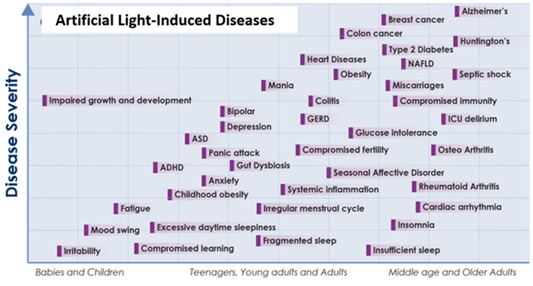
Figure 3: The health impact of exposure to the wrong light at the wrong time (Adapted from Sulli et al (2018) Trends Pharmacol. Science)
Consensus on healthy lighting specifications
To make healthy lighting science applicable and practical the specifications for healthy lighting must be defined. The most important specifications for lighting manufacturers are those that define the lighting source rather than the eye level illumination. (For example, with visual specifications manufacturers focus on the lumens emitted by the light source rather than the lux falling on surfaces of which they have little control).
Scientific consensus committees should be formed to develop and periodically update specific recommendations. Because of different fields of scientific expertise, and different health applications, separate consensus committees should be formed to cover:
1. Circadian lighting specifications
2. Red and infrared lighting specifications
3. Violet and ultraviolet lighting specifications
4. Other lighting specs (e.g., green for pain management) as these fields mature.
Each scientific consensus should be updated every three years as science progresses.
Support of manufacturer healthy lighting product development
Manufacturers should be encouraged to develop healthy lighting products. They will need education on the lighting specifications that promote health for building occupants. This enables them to design and engineer their own proprietary products to meet the scientifically validated specifications.
This will enable lighting specifiers to use a combination of SKUs from different manufacturers to meet the design aesthetic of a space, while delivering the benefits of coordinated evidence-based health-promoting lighting.
Education of lighting designers and architects
Lighting designers educated on the specs for healthy lighting, and architects educated on the use of natural daylight will be the key movers in implementing healthy lighting.
There will need to be a course and qualification in healthy lighting design that incorporates and explains the consensus healthy lighting specifications.
Addressing the regulatory barriers to installing healthy lighting products
The implementation of healthy lighting is impeded by a thicket of lighting laws, regulations, standards and building codes, most of which are driven by energy conservation goals without considering health impacts. These differ by jurisdiction so that the barriers in different countries and localities are somewhat different.
The metrics used in setting requirements in these regulatory barriers are often deficient and inappropriate for healthy lighting. For example, the V Lambda curve and lumens/watt are metrics which define visually-perceived brightness, but do not reflect the energy efficiency of delivering health-promoting light.
Changing these regulations and standards is a lengthy and time-consuming process. There are many vested interests and lobbies that resist change, because they argue it may be used by unscrupulous manufacturers to offer sub-standard products.
A better approach may be to define and seek approval of healthy lighting as a new product class not subject to vision-only lighting rules. The requirements to meet this new product class would be defined by the consensus healthy lighting specifications.
Management of manufacturer reps, lighting contractors and distributors
Lighting sales organizations, including manufacturer reps, lighting contractors, and distributors, often feel pressure to submit the lowest bid to win lighting contracts and maximize their commissions. This leads to the temptation to substitute cheaper unhealthy lighting even when healthy lighting is requested. To combat this, purchasers of lighting products, and ultimate end users, need to provide spec locks for healthy lighting that make substitutions difficult. In turn sales teams should be educated on how to sell the ROI of healthy lighting to justify higher pricing.
Education of building owners and facility managers
In recent years building owners and their facility managers have been incentivized to purchase the most “energy efficient” lighting (measured in lumens per watt) at the lowest price. The utility industry has offered rebates to reduce the price of purchasing high lumens per watt lighting, and corporate managers have been provided bonuses for converting to “energy efficient” LEDs that reduce the electric utility costs.
Building owners should be educated on the increased value of their property that can be achieved by installing healthy lighting. Higher rents can be obtained which substantially increases the building’s value.
Education of building occupants and end users
Ultimately the people who benefit most from healthy lighting, and are most negatively impacted by unhealthy lighting, are those who spend significant time in the illuminated space.
This means it is the employees rather than the short-term visitors to an illuminated space (i.e. store employees vs shoppers) who are most impacted.
It is important that these employees and their employers be educated about the benefits and ROI of healthy lighting based on their individual interests. There is one set of arguments for healthy lighting that will appeal to the employee, and another set for the employer.
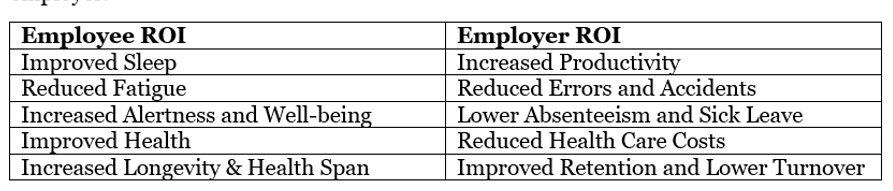
In the case of residential facilities such as hospitals, nursing homes, and assisted living facilities, it is the patient who will benefit even more from healthy lighting than the employees, although both are significantly impacted.
These end users need to be educated on the healthy lighting specs that they should demand from the owners and managers of the space. Essentially, they should be providing healthy lighting “spec locks” that make it difficult for the lighting sales organizations and building owners to substitute cheaper unhealthy lighting products.
Further Reading
The quickest way to understand the importance of healthy lighting is to read my book THE LIGHT DOCTOR.

Become an Annual Paid Subscriber to THE LIGHT DOCTOR newsletter
and get The Ultimate Circadian Bedroom Lighting Package as a free gift of healthy light and restful sleep with each new Annual Paid Subscription to THE LIGHT DOCTOR newsletter.
Here are the benefits you unlock with each new Paid Annual Subscription to THE LIGHT DOCTOR newsletter beginning today:
Ultimate Circadian Bedroom Lighting Package mailed to your home (for USA residents only*), including:
Latest edition of THE LIGHT DOCTOR book.
Blue-free book reading light - so you can read the book in the evening without any blue light exposure
Two A-19 automatic OIO circadian light bulbs which automatically cycle between blue-rich days, blue free evening lights and red night lights – so that your lighting is always healthy
OIO loop which enables you check any light fixture or bulb to see if it is providing healthy light appropriate for the time of day or night.
Hallway and bathroom blue-free night lights which automatically switch on when it is dark - so you safely walk to the bathroom without switching on the lights
Unlimited year-long access to all THE LIGHT DOCTOR newsletters, podcasts and premium resource materials.
Catalog of evidence-based healthy lighting products from reliable vendors.
The Ultimate Circadian Bedroom Lighting Package is the ideal gift for family and friends (or yourself) so you can bless them with healthy light and restful sleep,
Give yourself and your loved ones the gift of healthy bedroom lighting with each new Annual Paid Subscription to THE LIGHT DOCTOR newsletter
If you are already a paid monthly subscriber and wish to take advantage of this offer please go to the subscribe page and upgrade your subscription to an Annual Paid Subscriber
Thanks again for supporting our campaign for healthy lighting
PLEASE NOTE: *The Ultimate Circadian Bedroom Lighting Package can only be shipped to USA residents because of electrical compatibility and current tariff fees. Residents of other countries who sign up for an Annual Paid Subscription to THE LIGHT DOCTOR newsletter will be shipped a signed copy of the latest edition of THE LIGHT DOCTOR.
We regret this offer is not available to monthly paid or complimentary subscribers - but you are welcome to upgrade to a Paid Annual Subscription
If you are already an Annual Paid Subscriber we will continue to honor your current lower annual subscription price when you automatically renew, but you will not receive the incentive package for new subscribers.
How can we fast track education and policy for schools? Students are in them all day which no doubt is impacting their health. We need an international educational and policy strategy that will make lighting as important to school building codes and design as lead and asbestos were
Any suggestions for product sources in the UK?