

Light at Night Substantially Increases Cardiovascular Disease Risk
Sleeping or working under bright light after midnight shortens your life

Cardiovascular disease remains the leading cause of illness and death worldwide1. Physicians typically urge us to eat a healthy diet, exercise regularly, stop smoking, and limit alcohol. Yet one major—and often overlooked—risk factor is hiding in plain sight: electric light at night.
A Powerful New Study Confirms the Danger
A groundbreaking analysis of nearly 89,000 participants in the UK Biobank study, recently published by Windred et al.2 has confirmed that nighttime light exposure is a significant driver of cardiovascular morbidity and mortality.
In this large, well-controlled study, participants aged about 60, whose lifestyles exposed them to the highest levels of light between 12:30 a.m. and 6 a.m.—even while asleep—had a markedly increased risk of heart attack (myocardial infarction), stroke, and other cardiovascular diseases over the following eight years.
The takeaway is clear: light at night is not benign. It disrupts your circadian rhythms and your cardiovascular system pays the price.
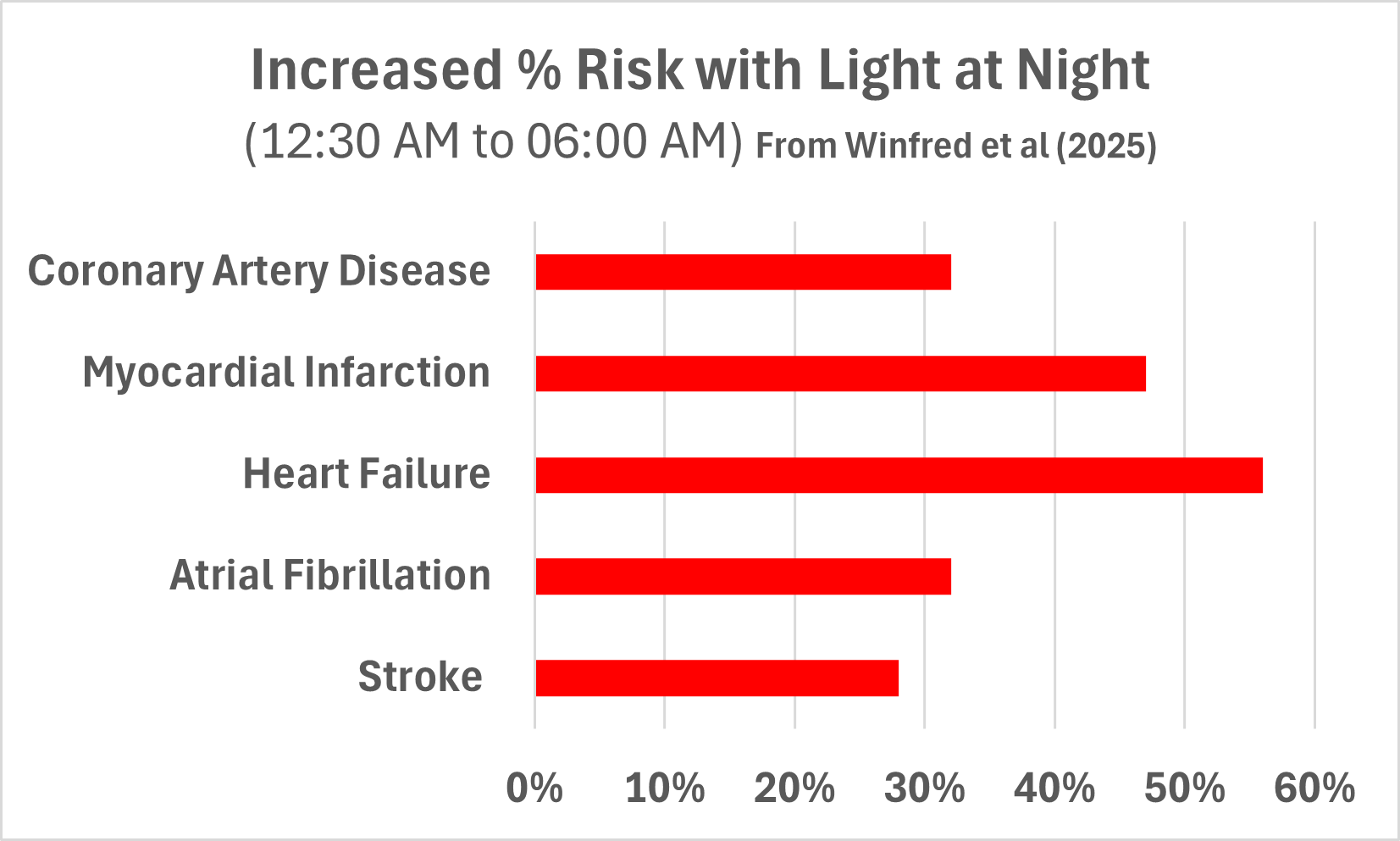
The Enormous Disease Burden of Light at Night
Just as light at night has been linked to obesity, diabetes, depression, and several common cancers, heart attacks and strokes now join the list of major contributors to early death and shortened lifespan caused by light at night.
As described in THE LIGHT DOCTOR, about 40–50% of adults sleep with some form of light on, and 15-20% work overnight shifts—both exposing themselves to unhealthy circadian disruption.
The good news: the solutions are simple and effective.
Sleep in total darkness. Block all light sources, including LEDs, clocks, and charging indicators. If you need to illuminate the way to the bathroom use dim orange-red lights near the floor.
If you must be awake at night, use circadian-safe “ZeroBlue” lighting with less than 2% energy in the 440–495 nm (blue) range.
Get 30–60 minutes of natural daylight each morning to strengthen your circadian rhythm. Morning light helps—but does not fully erase the harm caused by nocturnal light exposure.
To understand how profoundly light governs your biological clock and your health, read THE LIGHT DOCTOR.
Now Recognized by Mainstream Medicine
The American Heart Association (AHA) has just issued a Scientific Statement3 on the Role of Circadian Health in Cardiometabolic Health and Disease Risk. It emphasizes that the “circadian system plays a crucial role in maintaining health, including cardiovascular and metabolic function, and optimal health relies on robust circadian rhythmicity.”
This marks a turning point: after decades of evidence, circadian science is finally being integrated into mainstream cardiology and preventive medicine.
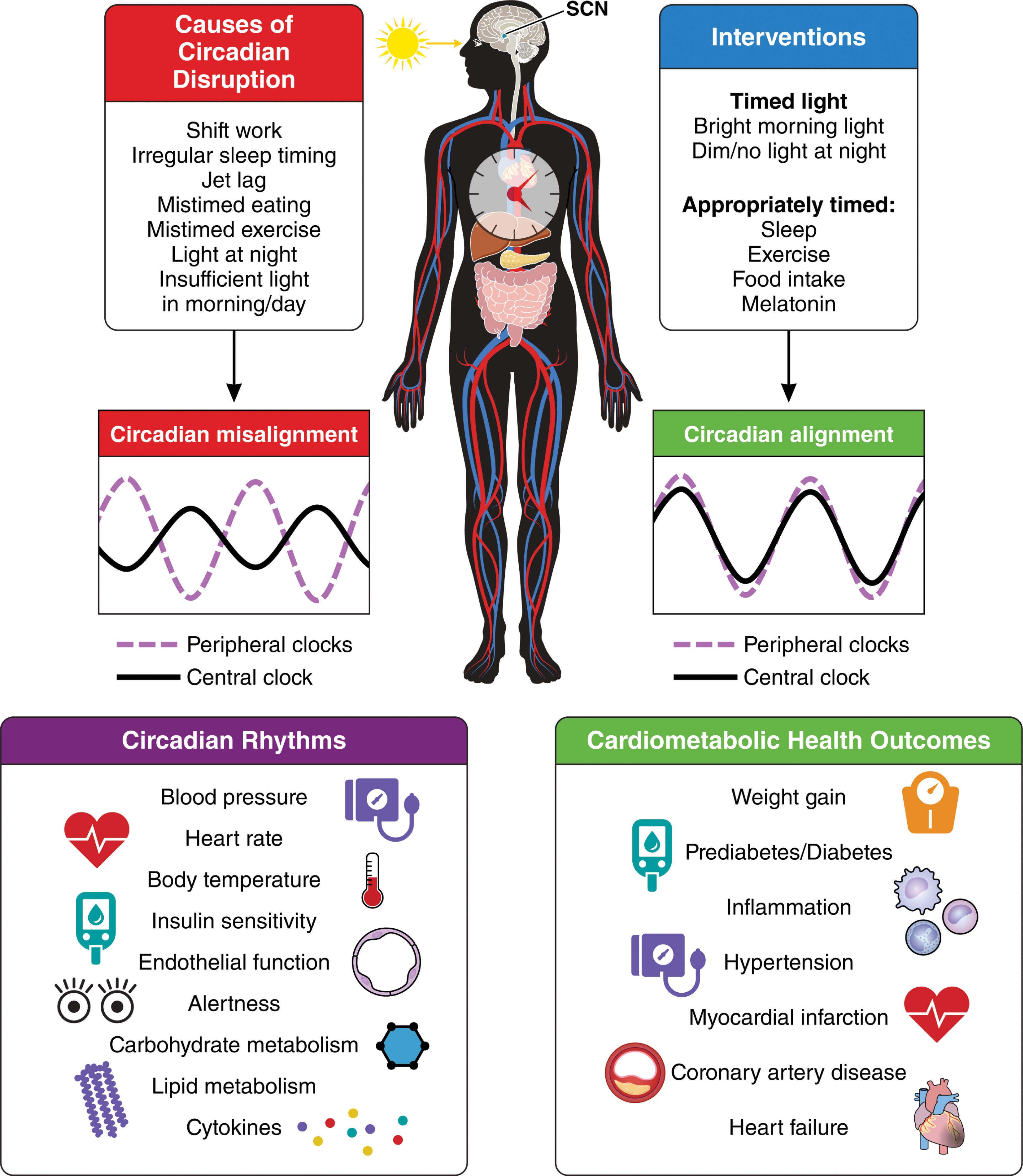
A 40-Year Journey Toward Recognition
Over forty years ago, I first warned of these connections in review articles published in the New England Journal of Medicine4 and Annual Review of Medicine5. It has taken nearly half a century for the medical establishment to recognize what circadian researchers have long known—that light at night is a hidden but powerful cause of heart disease.
Science moves slowly, but the message for your own life is immediate:
Protect your nights. Embrace healthy light by day, darkness by night. Your heart depends on it.
Sources

Remember the light we see is as important our health as the food we eat, the water we drink, and the air we breathe.
Vaduganathan M, et al (2022) The global burden of cardiovascular diseases and risk: a compass for future health. J AmColl Cardiol. 2022;80(25):2361-2371. doi:10.1016/j.jacc.2022.11.005
Windred DP et al. (2025) Light Exposure at Night and Cardiovascular Disease Incidence JAMA Network Open.;8(10):e2539031. doi:10.1001/jamanetworkopen.2025.39031
Knutson KL (Chair) et al. (2025) Role of Circadian Health in Cardiometabolic Health and Disease Risk: A Scientific Statement From the American Heart Association Circulation. 2025;152:e00–e00 https://www.ahajournals.org/doi/10.1161/CIR.0000000000001388
Moore-Ede, M.C., Czeisler, C.A., Richardson, G.S. (1983) Circadian timekeeping in health and disease. Part l: Basic properties of circadian pacemakers. Part 2: Clinical Implications for Circadian Rhythmicity NEJM 309: 469-476 and 530-536
Moore-Ede, M.C., Richardson, G.S. (1985) Medical implications of shift-work. Ann. Rev. of Med. 36: 607-617.
Check out the podcast on the degrees of health YouTube channel!
As always, great information !! Your book- The Light Doctor - is featured on our upcomming Newsletter coming out next Saturday https://lethealthbeyourguide.com/ and we have it in our books Resource section. Really appreciate all your knowledge and insight . Dr Dr Vikki King